


People from the Playground: Bill Kennedy
Here in Ohio's Largest Playground, it's truly our people who make our place. Through this People From the Playground blog series we aim to shine a spotlight on just a handful of the wonderful personalities that make our fun-filled corner of Southwest Ohio so special.
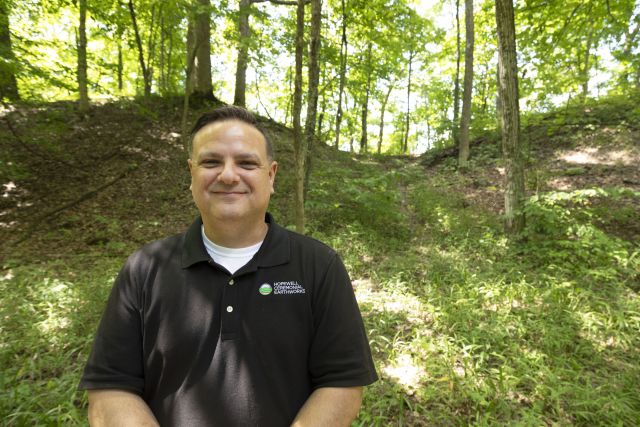
In this installment, we chat with Bill Kennedy, Site Manager and Site Archaeologist at Fort Ancient Earthworks & Nature Preserve - part of Ohio's first and only World Heritage Site, the Hopewell Ceremonial Earthworks.
Archaeology is such a fascinating field. How did you first get your start and what ultimately led you to your work here in Warren County?
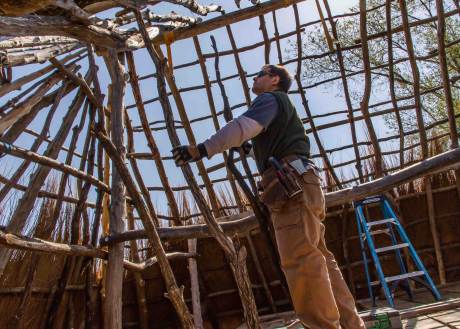
I grew up in (nearby) Greene County and developed an interest in local history and nature from my time in Scouting. After working as a scout camp nature director, I got my first museum job as a zookeeper at the Dayton Museum of Natural History (now the Boonshoft Museum of Discovery). Those were very formative years for me and although a zookeeper is mostly a janitor and cook, the animals stole my heart. I had a close bond with many of them, including a coyote, a bobcat, a goose, and others. At the same time, I started excavating in the summers with the museum’s Anthropology Department. I decided to major in Anthropology at Wright State and that sent me down the path that I’m still on today. I continued in school by earning a Master’s degree at Kent State where I studied the settlement patterns of some of the same sites where I had first excavated. After completing that degree, I was able to return to the museum, where I worked for about twenty years and began directing those same excavations. Over the years, my interests shifted as I worked closer with SunWatch Indian Village and I spent about a decade building replicas of ancient architecture. About six years ago, I came to the Ohio History Connection and eventually settled into a role as Site Superintendent for Fort Ancient and for Serpent Mound, which exactly overlapped with the same types of sites and questions where my interests began. I’ve also been teaching archaeology as an adjunct at Wright State for over 20 years, continually returning to my roots. From the outside, it might seem like I was built in a laboratory to do the exact job I’m currently doing, but it wasn’t planned. It was really the result of good timing and familiarity with the same subjects that numerous archaeologists in southwest Ohio often pursue.
Having studied, researched and explored so many historical sites over the years, what is it, from your expert perspective, that makes Fort Ancient and its fellow Hopewell Ceremonial Earthwork sites so incredible?
In many ways, American archaeology began in southern Ohio because of the extraordinary earthworks found here. The Hopewell Ceremonial Earthworks are the physical places where a large religious movement thrived between about 2000 and 1600 years ago. They are creative masterpieces because of their monumental scale, complex symbolism, and their testament to American Indian brilliance. The size of these earthworks is usually the first thing that people come to appreciate. The amount of earth moved to create Fort Ancient is the equivalent of 125 million basketloads (!) and it took centuries to complete. They are analogous to earthen cathedrals which incorporate complex ideas about cosmology that have been embedded into and are complemented by the landscape itself. They are masterpieces of human creative genius.
The Hopewell Ceremonial Earthworks earned UNESCO’s World Heritage designation in the fall of 2023. For those who aren’t familiar, what goes into becoming a World Heritage site and why is it such a badge of honor?
World Heritage is a designation given by UNESCO as a recognition of outstanding universal value in a place of cultural or natural heritage. Inscription is extremely difficult to achieve and this effort took about 18 years of work by many people and organizations, including tribal partners. Americans are usually not very familiar with World Heritage because we have so few, only 26 in the U.S. Americans recognize many of these places not necessarily because they are World Heritage sites, but because they are often our most famous National Parks and Monuments (such as Yellowstone or the Statue of Liberty). World Heritage is a designation that most people in the world recognize as a meaningful statement that some places are so special that their significance transcends national boundaries. They are worthy of recognition by all of humanity.
Fort Ancient’s museum is packed with incredible sites, artifacts and exhibits highlighting Ohio’s earliest people. If you had to recommend just one (or two) must-see items at the museum to a first-time visitor what would those be?
The most important highlight of Fort Ancient isn’t an object, but the place itself and the story that it represents. The museum at Fort Ancient is the only place in Ohio that attempts to tell the entire story of American Indians in Ohio, beginning in the Ice Age and continuing past European contact to the present day. This allows visitors to understand Fort Ancient in the context of this larger story and consequently, to also understand how other places like Serpent Mound and Miamisburg Mound relate to that story as well. In the center of the museum, there is a large model of Fort Ancient and that’s helpful in understanding a place that is so massive that it can’t be fully appreciated from the ground. The model also helps visitors to understand how Fort Ancient complements its unique landscape, the astronomical alignments, and how its current appearance differs from the past. Another great way to experience Fort Ancient is to walk the three miles of nature trails at the site, which help visitors to understand the beautiful natural landscape of the earthwork.
We hear so often the incredible story of Fort Ancient’s past. What excites you most about its future?
I’m most excited about what World Heritage inscription means for the future. World Heritage attracts a lot of attention and this represents an opportunity to tell the story to a larger audience. More people will have the opportunity to learn about this special place and more people will hopefully come every year. I’m excited about the opportunity to reach new audiences. Since inscription, one pattern we’ve noticed is that more visitors come in with questions because they’ve already been learning about these places prior to visiting.
As America celebrates its 250th birthday this year, Warren County’s numerous historical highlights will have their time to shine. What other museums, sites or historic happenings in Warren County would you recommend visitors check out in 2026?
Among others, the Harmon Museum in Lebanon is a great place to visit and showcases the long history of Warren County. Ohio 250 is sponsoring many events across the state, which visitors can explore at https://america250-ohio.org/events-calendar/ Not all events have been posted yet, but there are many across the state. Near Warren County, people should check out the new and impressive Great Council State Park, which has recently opened and tells the story of the Shawnee village of Old Chillicothe between Xenia and Yellow Springs.
When you aren’t on site at Fort Ancient, where else might folks find you enjoying your time here in Warren County? What other Warren County events, attractions, restaurants or shops would you recommend to visitors?
I’ve been spending more time in Morrow this year, which is only a few miles from Fort Ancient. Morrow is growing as a destination and is conveniently located in a place where people can bike, hike, and canoe. It has good restaurants and ice cream and is a place that people are rediscovering as its downtown is being revitalized. I enjoy the Lebanon Arts Festival and we do a booth for Fort Ancient each year. Caesar’s Creek is also a great destination and I recently got to see the renovated nature center.